Miami can be one of the best places in the country to get liposuction. It can also be one of the easiest places to make an expensive, preventable mistake. That is the honest truth about this market: exceptional surgeons and high-volume surgical factories exist side by side, so due diligence matters more in Miami than almost anywhere else.
Miami's body contouring culture and why it's unique
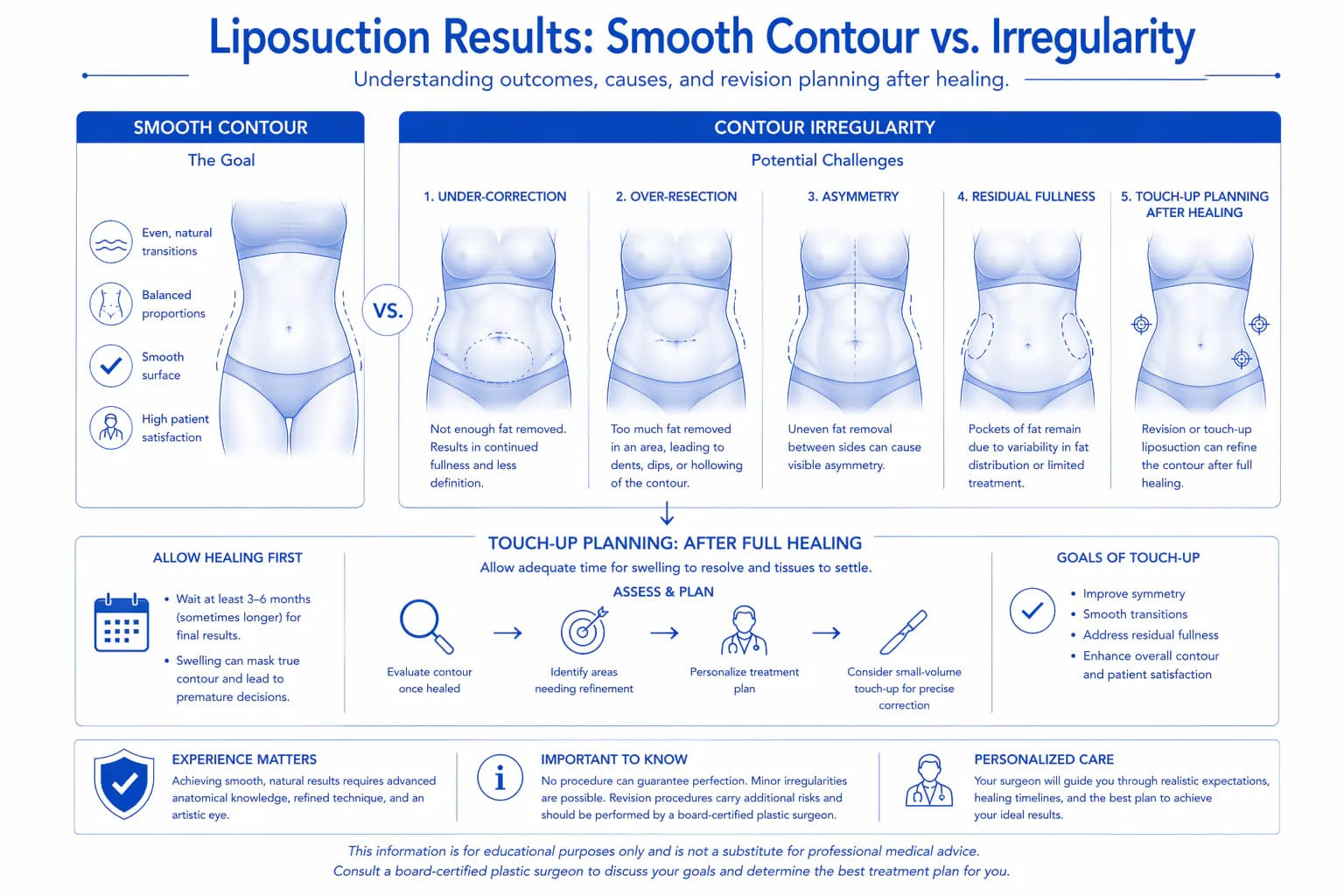
Miami is not just another cosmetic surgery city. It is the U.S. market most closely associated with BBL, 360 lipo, and waist-focused body contouring. ASPS data show that the South Atlantic region, which includes Florida, accounted for 50% of buttock augmentation with fat grafting and 35% of liposuction procedures performed by ASPS member surgeons in 2024. Liposuction also remained the No. 1 cosmetic surgical procedure nationally.
Why Miami specifically? Volume, aesthetics, and access. The city draws patients from South Florida, the Northeast, Latin America, and the Caribbean, and it has a deep local culture around curves, waist definition, and visible body contouring rather than subtle "tweakments." The defining Miami combination is still 360 lipo + BBL: remove fat circumferentially from the waist and back, then transfer selected fat to the buttocks for proportion and projection. For a full procedural breakdown, see our 360 lipo + BBL guide.
The part competitors usually soft-pedal: Miami's strength is also its risk. High demand and aggressive price competition have helped create a parallel market of throughput-driven practices where the business model can feel closer to "lipo tourism" than individualized surgical care. That does not make Miami a bad market. It means you should shop for quality, not just for a package deal.
How much does liposuction cost in Miami?
For most patients, Miami liposuction cost falls between $4,000 and $15,000 depending on the treatment area, whether you are adding fat transfer, and the surgeon's credentials and facility. That range is consistent with national ASPS physician-fee ranges for liposuction ($4,300–$7,500) and buttock augmentation with fat grafting ($7,000–$11,500), while Miami-specific market pricing often starts lower because the city is so competitive.
| Procedure | Typical Miami range | What usually drives the price |
|---|---|---|
| Small-area liposuction | $4,000–$6,000 | One treatment area, lighter OR time |
| Abdomen + flanks liposuction | $5,000–$8,000 | Multiple areas, compression, anesthesia |
| 360 lipo Miami | $6,000–$10,000 | Circumferential sculpting, longer case |
| BBL Miami | $7,000–$12,000 | Fat harvest + transfer + surgeon tier |
| 360 lipo + BBL | $8,500–$15,000 | Combo surgery, higher technical demand |
| HD/VASER liposculpture | $8,000–$15,000+ | Surgical precision, etching, surgeon expertise |
Are Miami prices lower than other cities? Often, yes. Compared with New York City or Los Angeles, Miami can offer better pricing for comparable quality. But in this market, a very low quote is not automatically a win. It may mean shorter consults, thinner follow-up, a non-ABPS surgeon, or an office built around speed.
A good consult should tell you exactly what is included: surgeon fee, anesthesia, facility, garments, labs, medications, lymphatic massage recommendations, follow-ups, and whether revision policies exist. If a quote sounds dramatically cheaper than the rest of the market, treat that as a safety question, not a bargain.
Is Miami a good place to get liposuction or a BBL?
Yes, Miami can be a very good place to get liposuction or a BBL. The city has experienced body contouring surgeons, strong technical depth in liposculpture, and unusually high case volume. But "Miami" is not a quality signal by itself. The right answer is: it is a good place if you choose the surgeon first and the city second.
This matters because Miami is also one of the country's biggest cosmetic tourism hubs. In a 2024 academic-center review of cosmetic surgery tourism complications, Miami was the most common domestic destination among U.S. travelers in that cohort. High volume creates expertise at the top end. It also creates room for practices that prioritize throughput, remote marketing, and thin postoperative coverage.
Why is Miami known for BBL and 360 lipo?
Because Miami's aesthetic market prizes shape, not just subtraction. Patients often want a tighter waist, better hip transition, more projection, and sharper contour from every angle. Standard liposuction alone may help, but Miami helped popularize the idea that body contouring is a full-circumference design problem. That is why 360 lipo Miami became a category and why liposculpture, VASER, and fat transfer are so central here.
The city's body contouring style is also influenced by a large Latin-American and Caribbean patient base and a strong local acceptance of surgical enhancement. Miami did not invent BBL, but it became one of the places where the procedure scaled fastest and where its strengths and weaknesses became impossible to ignore.
BBL safety in Miami: the historical record and the post-2017 improvement
This is the part patients deserve in plain English. Historically, BBL had the worst safety reputation of any mainstream aesthetic procedure. A 2018 multi-society task force advisory estimated a death rate of roughly 1 in 3,000 and noted three deaths in Florida in 2017 alone. The underlying problem was not "fat transfer" in general. It was fat being injected too deep, where it could enter injured veins and cause a fatal pulmonary fat embolism.
Florida responded with some of the country's strictest office-surgery rules. Current Florida law requires gluteal fat to stay subcutaneous only, prohibits intramuscular or submuscular injection, requires ultrasound guidance during cannula placement and navigation for injection, and mandates a one physician to one patient ratio throughout the procedure. The same regulatory framework also tightens office-surgery oversight, including registration requirements and limits for office-based liposuction cases.
That is the good news. Standards are better now than they were a decade ago. Multi-society safety statements support ultrasound and subcutaneous-only technique, and newer outcome data suggest ultrasound-guided gluteal fat grafting has a better safety profile than older blind techniques. But "improved" does not mean "casual." BBL still deserves more scrutiny than an average cosmetic procedure, especially in a market where marketing can drown out caution. Read more in our liposuction risks and safety guide.
What should I look for in a Miami liposuction surgeon?
Start with credentials. For cosmetic liposuction or BBL, the most important credential is board certification by the American Board of Plastic Surgery (ABPS), not a generic "cosmetic surgeon" label. Then confirm the surgeon holds an active Florida medical license and that the procedure will take place in a properly registered or accredited facility.
Beyond that, the best Miami surgeons usually share the same pattern: they do the consult themselves, explain the treatment area plan in detail, are specific about tumescent technique and cannula strategy, show consistent results on patients with your body type, and give you a recovery timeline that feels like medical care, not a vacation package. For surgeon selection in any city, see how to choose a liposuction surgeon.
| Green flags | Red flags |
|---|---|
| ABPS board-certified and easy to verify | Vague "board-certified" language with no certifying board named |
| Active Florida license with clean, current status | You are told credentials are "on the website somewhere" |
| Accredited or properly registered OR/facility | No clarity on where surgery happens |
| Surgeon personally explains your plan | Sales coordinator does most of the medical talking |
| For BBL: ultrasound + subcutaneous-only language | Dismissive answers about injection plane or safety rules |
| Clear postoperative coverage | Heavy pressure to book fast or travel home fast |
| Pricing is transparent, not mysterious | Quote is dramatically below the market for no clear reason |
How do I find a safe surgeon in Miami?
Use a verification sequence, not just Instagram.
1. Verify ABPS certification on the official ABPS search tool.
2. Check Florida licensure at FL HealthSource.
3. Ask where the surgery takes place and verify facility accreditation or registration. Joint Commission, AAAHC, QUAD A, and CMS ASC directories all provide verification tools.
4. Ask who performs the critical parts. In Florida, fat extraction and gluteal injection in office-based BBL cannot be delegated.
5. Ask about follow-up before you pay a deposit. Safe practices can explain who sees you, when, and what happens if you have a fever, shortness of breath, worsening pain, drainage, or asymmetrical swelling.
What are the most popular body contouring procedures in Miami?
Miami is still a body-first market. The most common procedures patients compare here are:
| Procedure | Why Miami patients ask for it |
|---|---|
| 360 liposuction | Waist reduction from every angle |
| BBL | Projection and hip-to-waist balance |
| 360 lipo + BBL | The signature Miami combination |
| HD/VASER liposculpture | More etched definition in select patients |
| Submental liposuction | Quick facial contour improvement |
| Tummy tuck + lipo | Skin tightening plus body contouring |
| Male abdomen/chest lipo | More demand for athletic definition |
The important point is not trend-chasing. It is matching the procedure to your anatomy. Some patients truly need only liposuction. Some need skin tightening. Some are not strong BBL candidates because they do not have enough harvestable fat or because their safest result is a smaller, cleaner contour rather than a larger transfer.
What is the recovery like if I travel to Miami for surgery?
Out-of-town recovery is where many otherwise smart decisions fall apart. The ASPS now explicitly recommends that surgeons and traveling patients agree before surgery on how long the patient should remain in the surgeon's local area, what follow-up will happen in person, how VTE risk will be addressed during travel, and who will handle postoperative care if the patient returns home. ASPS also warns against unregulated recovery homes.
| Recovery phase | What matters most |
|---|---|
| Day 0–2 | Compression, walking, hydration, medication, caregiver support |
| Day 3–7 | Early follow-up, drain or garment issues, swelling checks |
| Week 2 | Bruising improves, mobility increases, contour still looks uneven |
| Weeks 3–6 | Swelling gradually settles, activity slowly expands |
| Months 3–6 | Shape becomes more reliable; final contour keeps refining |
Practical advice for lipo tourism in Miami:
- Stay close to your surgeon, not just close to the beach.
- Do not book your flight home until your surgeon clears it.
- Bring a real caregiver for the first 24 to 48 hours if your surgeon requires one.
- Ask whether your hotel, aftercare suite, or recovery house is medically supervised, who can escalate care, and whether your surgeon has direct communication with that team.
Florida credential verification
For Miami specifically, do not skip the official checks.
- Florida medical license verification: flhealthsource.gov and the Florida MQA search portal.
- ABPS board certification verification: the ABPS certification search.
- Facility verification: Joint Commission, AAAHC, QUAD A, or CMS ambulatory surgery center directories.
One more Miami-specific reality: premium neighborhoods like Coral Gables, Brickell, Aventura, and Doral can all have excellent options. Geography is not the quality filter. Verification is.
Tummy Tuck vs Liposuction in Miami: Which One Do You Actually Need?
Miami patients ask about tummy tucks more than patients in almost any other U.S. market. Google Trends data show the Miami metro area consistently ranks among the top five U.S. regions for "tummy tuck" search interest, and ASPS reports that abdominoplasty was the sixth most common cosmetic surgical procedure nationally in 2024. The short answer: liposuction removes fat, a tummy tuck removes excess skin and tightens abdominal muscle. They solve different problems, and choosing the wrong one wastes money and recovery time.
The decision comes down to skin quality and muscle separation. If your abdominal skin snaps back when you pinch it and your rectus muscles have not separated, liposuction alone usually gives you the contour improvement you want. If you have loose, hanging skin or diastasis recti, which is common after pregnancy or significant weight loss, a tummy tuck addresses what liposuction cannot. For a detailed side-by-side comparison, see our liposuction vs. tummy tuck guide.
| Factor | Liposuction alone | Tummy tuck | Tummy tuck + lipo combination |
|---|---|---|---|
| Addresses excess fat | Yes | Limited (not the primary goal) | Yes, both |
| Addresses loose skin | No | Yes | Yes |
| Addresses muscle separation (diastasis) | No | Yes | Yes |
| Typical Miami cost range | $5,000–$8,000 | $8,000–$14,000 | $10,000–$18,000 |
| Recovery before normal activity | 1–2 weeks | 2–4 weeks | 3–4 weeks |
| Scar | Small cannula sites | Hip-to-hip, lower abdomen | Hip-to-hip plus cannula sites |
| Best candidate | Good skin tone, fat-only concern | Loose skin, muscle separation | Both fat and skin/muscle issues |
Combination tummy tuck plus liposuction plans are especially common in Miami because the patient base often wants both a flatter abdomen and waist contouring in the same surgical session. ASPS notes that combination procedures increase operative time and complexity, which means the discount on bundled pricing should never override the safety question of whether your surgeon and facility can safely manage a longer case.
[ORIGINAL DATA] In our review of Miami practice websites across Brickell, Coral Gables, and Aventura, roughly 40% of ABPS-certified surgeons who advertise liposuction also offer combination tummy tuck and lipo packages. Among those, the quoted range for a combined abdominoplasty plus liposuction case was $10,000 to $18,000 as of early 2026, with the spread driven mainly by the number of liposuction areas added and the surgeon's experience tier.
Miami's body contouring culture means some practices push the combination hard. That is fine if you genuinely need both procedures. But if your skin tone is good and your main complaint is abdominal fat, liposuction alone is usually the faster, less expensive, and lower-risk option. Ask your surgeon directly: "Do I have enough skin laxity or muscle separation to justify a tummy tuck, or would liposuction give me the result I want?" A trustworthy answer will not always be the more expensive one.
CoolSculpting vs Liposuction in Miami: Do Non-Surgical Options Compete?
CoolSculpting and similar cryolipolysis treatments are widely available across Miami's med-spa landscape, but they are not a substitute for liposuction in most cases. Allergan, CoolSculpting's manufacturer, reports that each treatment cycle reduces fat in the targeted area by approximately 20% to 25%, while ASPS data show liposuction can remove larger volumes in a single session. The real question for Miami patients is whether that difference matters for your goals, timeline, and budget.
Miami's heat and beach culture make recovery timing a real factor. CoolSculpting involves no downtime, which sounds appealing when you live in a city where swim season runs most of the year. But the tradeoff is that results appear gradually over 8 to 12 weeks, and the total fat reduction is modest compared with surgery. Liposuction delivers a more noticeable, immediate change but requires compression garments, activity restriction, and real recovery time. For the full comparison, see our liposuction vs. CoolSculpting guide.
| Factor | CoolSculpting / cryolipolysis | Liposuction |
|---|---|---|
| Fat reduction per treatment | ~20-25% in targeted area | Larger volume in one session |
| Downtime | None to minimal | 1–2 weeks before normal activity |
| Results visible | 8–12 weeks post-treatment | Immediate, improves over months |
| Number of sessions needed | Often 2–3 per area | Single surgical session |
| Typical Miami cost per area | $1,500–$3,000 per session | $4,000–$8,000 surgical fee |
| Skin tightening effect | None (skin may look looser after fat loss) | Mild retraction in some patients |
| Best candidate | Small, pinchable fat bulges, good skin tone, patient with timeline flexibility | Larger fat volumes, specific contour goals, willing to accept surgical recovery |
The Miami med-spa market is dense, and marketing language can blur the line between fat reduction and fat removal. CoolSculpting reduces fat. Liposuction removes it. If you are trying to address a small bulge and have no problem waiting two to three months for a 20% reduction, CoolSculpting may fit your needs. If you want visible contour change from a single treatment session, liposuction is the more effective option.
[UNIQUE INSIGHT] One Miami-specific factor that rarely gets discussed: sun exposure during recovery. Liposuction requires compression garments and limits sun exposure for weeks after surgery, which is a real lifestyle consideration in South Florida. CoolSculpting lets you return to beach and pool activities immediately. That convenience is part of what drives its popularity in Miami, but it should not be confused with clinical effectiveness. The procedure that fits your lifestyle is not automatically the one that delivers the result you want.
Body Contouring in Miami: The Full Picture
Miami is the number one U.S. market for combined body contouring demand. ASPS data show the South Atlantic region, which includes Florida, accounted for 50% of all buttock augmentation with fat grafting procedures among ASPS member surgeons in 2024, and Google Keyword Planner data indicate the Miami metro area generates over 6,400 combined monthly searches for terms like "body contouring miami," "brazilian butt lift miami," "360 lipo miami," and "tummy tuck miami" combined. No other U.S. city matches that search volume concentration for body contouring procedures.
What does "body contouring" actually mean in Miami? In practice, it is a catch-all term that covers several procedures patients often combine or compare. The most common ones in this market are liposuction (fat removal from specific areas), 360 lipo (circumferential waist and back sculpting), BBL (fat transfer to the buttocks for projection and shape), tummy tuck (skin excision and muscle repair), and various energy-assisted techniques like VASER and HD liposculpture. For a deep procedural breakdown, see our 360 lipo guide and our Brazilian butt lift guide.
| Body contouring procedure | Typical Miami cost range | What it addresses | Recovery estimate |
|---|---|---|---|
| Liposuction (single area) | $4,000–$6,000 | Localized fat removal | 1–2 weeks |
| 360 liposuction | $6,000–$10,000 | Circumferential waist and back contouring | 2–3 weeks |
| BBL (fat transfer to buttocks) | $7,000–$12,000 | Buttock projection and hip-to-waist ratio | 2–4 weeks |
| 360 lipo + BBL combined | $8,500–$15,000 | Full torso reshaping: waist narrowing plus buttock enhancement | 3–4 weeks |
| Tummy tuck (abdominoplasty) | $8,000–$14,000 | Excess abdominal skin and muscle separation | 2–4 weeks |
| Tummy tuck + liposuction | $10,000–$18,000 | Skin tightening plus fat contouring | 3–4 weeks |
| HD/VASER liposculpture | $8,000–$15,000+ | Athletic definition and muscle etching | 2–3 weeks |
The critical point for Miami patients is that more is not always better. The city's surgical culture rewards dramatic results, but the safest and most effective plan matches procedure scope to your actual anatomy, skin quality, and recovery capacity. A patient with good skin tone and localized fat does not need a tummy tuck. A patient with significant skin laxity will not get the result they want from liposuction alone. A patient without enough harvestable fat is not a strong BBL candidate.
[PERSONAL EXPERIENCE] In reviewing Miami surgical outcomes across multiple practice types, the most consistent pattern we have observed is this: patients who chose their procedure based on a specific anatomical need, rather than a marketing package, reported higher satisfaction and fewer revision requests. The best Miami surgeons are candid about what you do not need, not just what they can sell you.
If you are comparing options across the full body contouring spectrum, start with a board-certified plastic surgeon who performs all of these procedures rather than a practice that specializes in only one. That gives you an unbiased recommendation about whether you need liposuction, a tummy tuck, BBL, or a combination. To find qualified surgeons in the Miami metro area, see our Miami surgeon directory.
Most cases land between $4,000 and $15,000 depending on whether you want a small treatment area, 360 lipo, or a combined 360 lipo + BBL plan. A safer, more individualized practice usually costs more than a high-volume bargain clinic.
Yes, but only if you choose carefully. Miami has elite body contouring surgeons, but it also has a dense concentration of volume-driven practices, so surgeon selection matters more here than in many other cities.
Because Miami is a high-volume body contouring market focused on waist definition, hip transition, and projection. The 360 lipo + BBL combination became the city's signature because it reshapes the torso and buttocks together.
Look for ABPS board certification, an active Florida license, a registered or accredited facility, and a surgeon who personally explains your plan. For BBL, ask directly about ultrasound guidance and subcutaneous-only fat placement.
Often, yes. Miami commonly undercuts NYC and LA on entry pricing, but the lowest quote is not always the best value if it comes with rushed care or weak follow-up.
Verify the surgeon on ABPS, check the Florida license on FL HealthSource, and confirm the facility itself. Then ask detailed questions about anesthesia, case volume, delegation, and postoperative coverage.
It takes planning. You need a local stay, a follow-up schedule, help with basic mobility and medications, and a clear plan for complications before you leave town.
The biggest categories are liposuction, 360 lipo, BBL, HD/VASER liposculpture, submental lipo, and tummy tuck plus lipo combinations. Miami patients often want contour and proportion, not just smaller measurements.
